
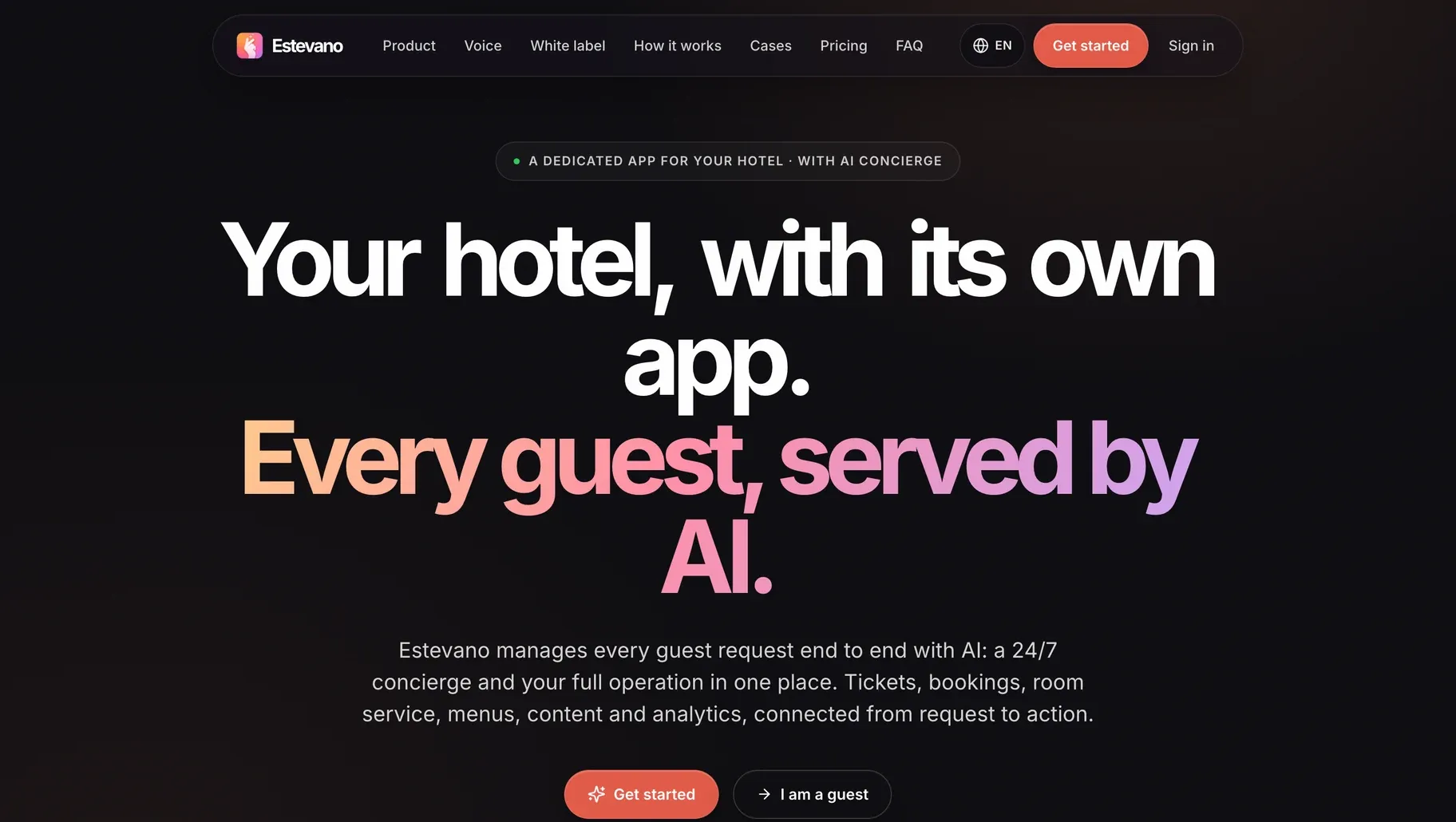
Estevano: the guest app and staff console that runs a hotel's day
Estevano is Polargate's own hotel product: a guest app, an AI assistant and a staff console that turn a request into a routed ticket with an owner and a clock. It has been in production at Santo Domingo Bay for months, where it handled around 2,500 real guest requests in four months with a median resolution time of sixteen minutes.
- ~2,500
- guest requests handled in four months at the first hotel
- 16 min
- median time to resolve a request (mean 25)
- 3 min
- median time to first response (mean 8)
- 93%
- of requests raised by the guest, with no queue and no phone call
- 90%
- resolved within the hour, p90 around 59 minutes
- 68 / 68
- database tables with row-level security, data hosted in the EU
The problem
In most hotels a guest request travels by voice. The guest calls reception or stops someone in a corridor, reception writes it on paper or in a chat group, and somebody remembers to tell housekeeping. Nothing carries a state, nobody owns it, and no one can say afterwards how long it took or how often it happened. The hotel finds out it has a problem when the review is published. The tools on the market solve the conversation with the guest before and after the stay, through email, WhatsApp and campaigns, and leave the hours in between, the ones the guest actually experiences, to paper.
What we built
Estevano puts the request itself in the system. The guest opens the app, or writes to the AI assistant in their own language, and what comes out is a ticket with a type, a department, a room, a state and a clock. Room service, housekeeping, maintenance, reception, IT, restaurant and security each see their own queue in a staff console, with the alarm sounding on the phones of the people on shift. The hotel's data comes from its PMS: the Opera Cloud connector syncs every five minutes and has been in production for months, and a hotel with no connector can still start, because reception can register a guest by hand or send a QR with an expiring token.
The outcome
At Santo Domingo Bay the product has been running for months on real guests. In one four-month window it handled around 2,500 requests, roughly twenty a day, and effectively all of them were closed. The median request was resolved in sixteen minutes and answered in three, 90 percent were finished inside the hour, and 93 percent were raised by the guest in the app or through the assistant rather than at a desk. Room service and housekeeping are two thirds of the volume, which is what tells the hotel where its staff hours actually go.
Stack
- React
- TypeScript
- Expo
- Capacitor
- Supabase
- PostgreSQL
- Deno
- iOS
- Android
- Firebase
- Vercel
- Stripe
- Claude
- GitHub Actions
The context
A hotel's day is made of small requests. A towel, a late breakfast, a broken air conditioning unit, a table at eight. In most hotels none of that is written down anywhere a manager could read later: it travels by voice, gets noted on paper or in a staff chat group, and is either done or forgotten. The tools the industry sells are built around the conversation with the guest before and after the stay, through email campaigns and WhatsApp. The hours in between, the ones the guest actually remembers, are left to memory.
Estevano is Polargate's answer to that, and it is our own product rather than a client's: we build it, we run it and we sell it. That is also why it is on this site. It is the longest running proof of what we build.
What it is
Three pieces that only make sense together.
- A guest app, and a web version for hotels that prefer no install, where the guest orders room service, reports a problem, books an outlet or asks a question.
- An AI assistant that reads the request in the guest's own language and turns it into the right kind of ticket, with retrieval scoped to that hotel and nothing else.
- A staff console where every department, room service, housekeeping, maintenance, reception, IT, restaurant and security, sees its own queue, takes ownership and closes with a state, with the alarm sounding on the phones of whoever is on shift.
Behind them, the hotel's own data: the Opera Cloud connector has been in production for months and syncs every five minutes. A hotel without that connector can still start on day one, because reception can register a guest by hand or send a link with an expiring token by email, SMS or WhatsApp.
What the numbers say
Santo Domingo Bay has been running it with real guests for months. Over a four-month window it handled around 2,500 requests, about twenty a day, and effectively all of them were closed.
- Median resolution: 16 minutes. Mean 25.
- Median first response: 3 minutes. Mean 8.
- 93 percent of requests were created by the guest through the app or the assistant, with no queue and no phone call.
- 90 percent were resolved inside the hour, with a p90 around 59 minutes.
- Room service is 37 percent of the volume and housekeeping 28 percent, so two thirds of everything a hotel is asked for lands in those two departments.
That last line is the one general managers stop at, because it is the first time the hotel can see where its staff hours actually go.
How it is built
The product started as a React application packaged with Capacitor. Scaling audits pushed us to native hybrid apps in React Native: a global guest app for hotels on the standard plans, a branded guest app for hotels on the top plan, and a single staff app that works across every hotel a person belongs to. Postgres, Storage, Auth and Edge Functions run on Supabase, with the data hosted in the EU.
Security was reviewed by an external consultant against 23 points. Row-level security is enabled on all 68 tables, staff authenticate with a server-side JWT, the guest PIN is hashed with bcrypt and locks out after repeated attempts, the AI retrieval layer fails closed when no hotel is identified, and CORS is allow-listed across 39 functions. Isolation was tested between two real hotels, with no cross-leak. Eleven of the 23 points are resolved and twelve, a WAF, an immutable log, a penetration test and MFA among them, belong to the scale roadmap rather than to daily operation.
What it does not do yet
Online check-in, identity verification and the digital room key are not in the product. They are on the roadmap and they are not written, so we do not present them as features. The same honesty applies to PMS coverage: Opera Cloud is in production, and any other PMS needs its own connector written against that vendor's API.
Why it belongs on this page
Everything Polargate sells to a hotel, the app, the operational plumbing, the AI that has to be right rather than chatty, the security posture a chain's IT team will ask about, exists here in production with real guests and measured numbers rather than as a promise.
Questions about this project
Does Estevano replace the hotel's PMS?
Does it do online check-in and digital room keys?
How is one hotel's data kept away from another's?
Can a single independent hotel use it, or is it for chains?
Related work
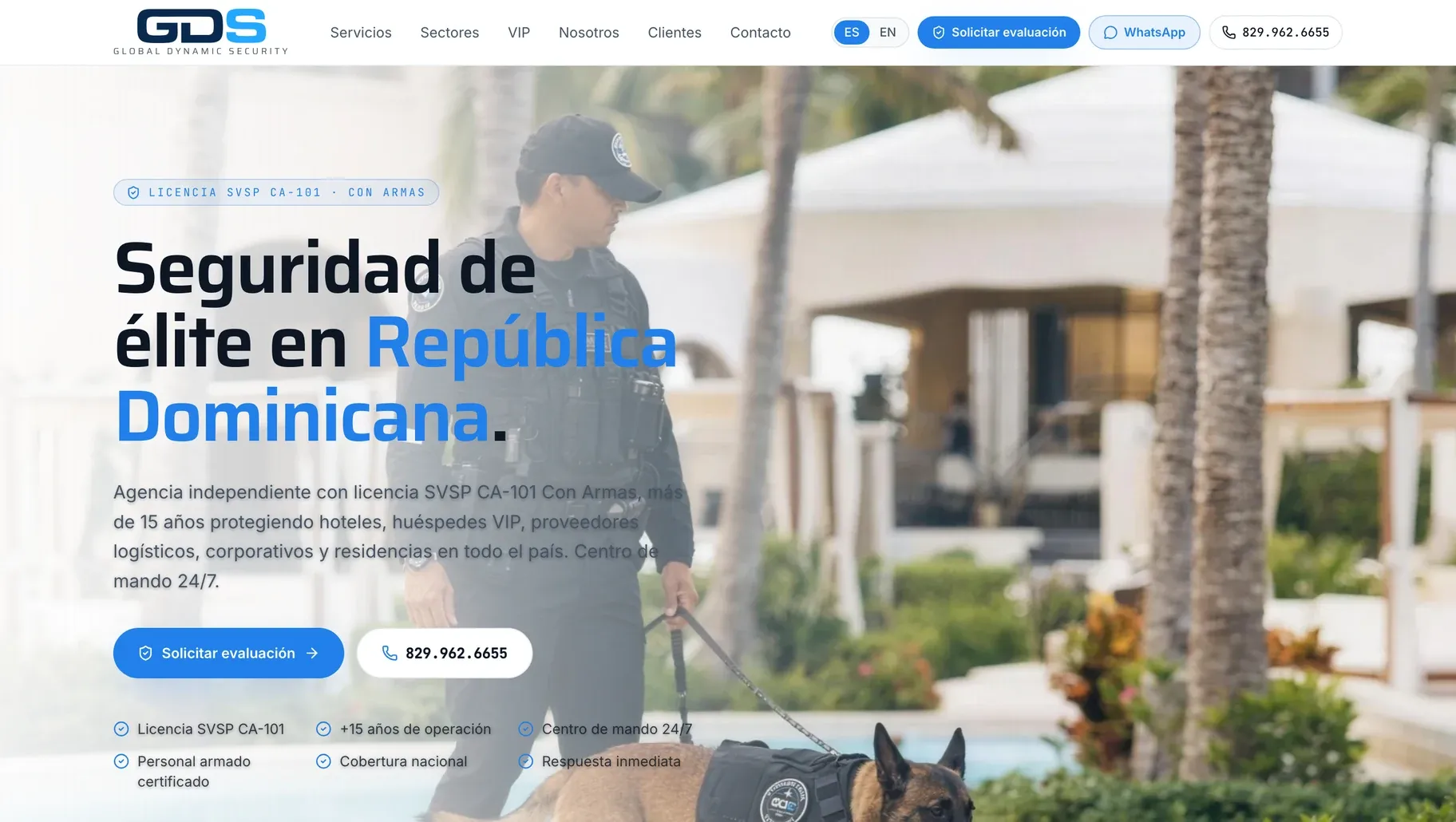 Global Dynamic Security Group
Brand and bilingual site for Global Dynamic Security Group
Brand identity, a 15-page identity manual and a bilingual Spanish and English corporate site for Global Dynamic Security Group (GDS), a security services group in the Dominican Republic, delivered as one fixed-price project.
2026Read the case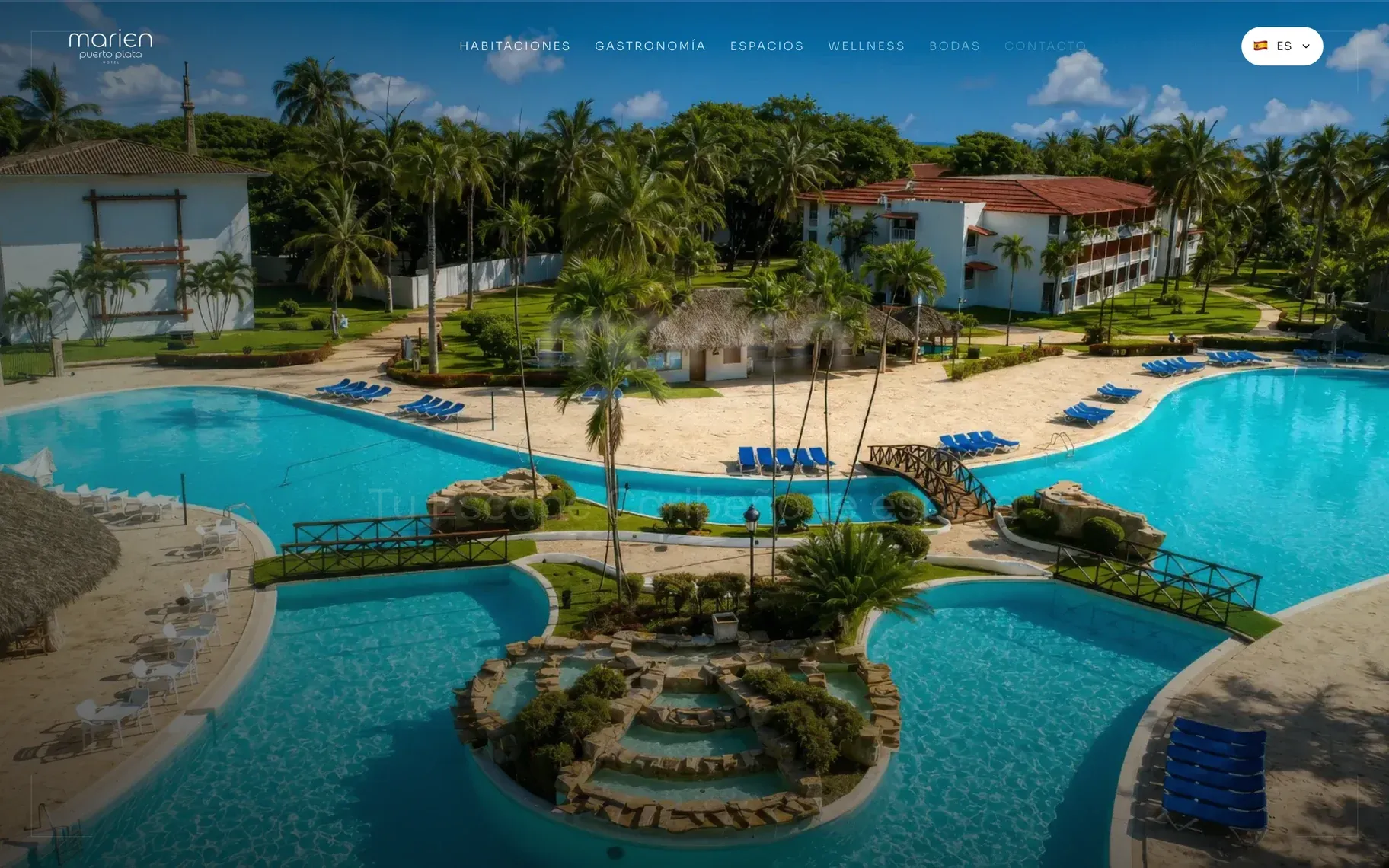 Hotel Marien
A resort website that Google, social scrapers and AI assistants can actually read
Polargate turned the bilingual website of a 349-room Caribbean resort into a fully static, hardened site with structured data for AI search, and keeps it under a monthly care retainer with an automated audit on the first day of every month.
2026Read the case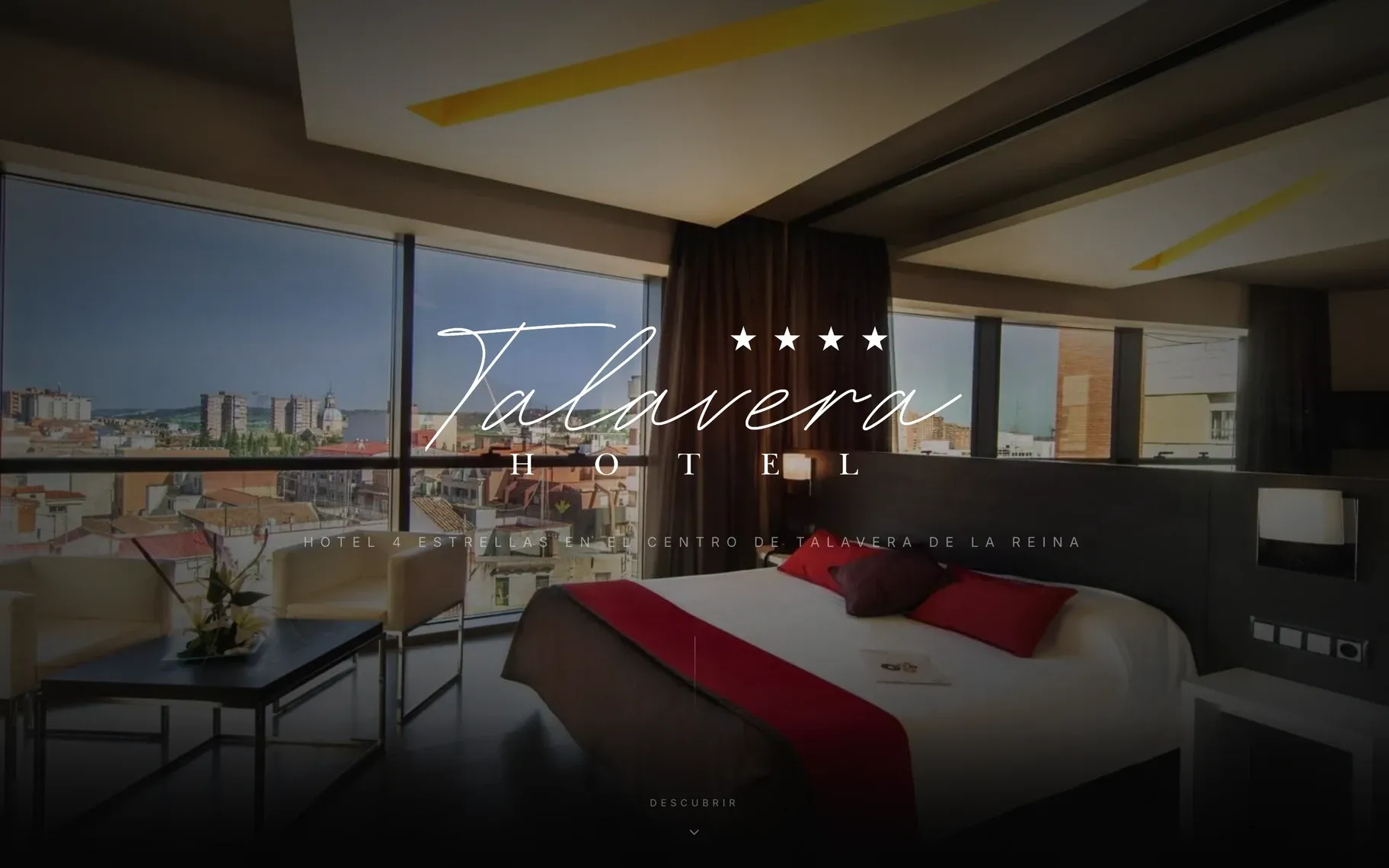 Hotel Talavera
A bilingual hotel website that crawlers and AI assistants can read
A 4-star city hotel in Castilla-La Mancha had a website that search engines received as an empty container. Polargate rebuilt it as 16 pre-rendered bilingual URLs and now runs it on a monthly Care retainer with a recurring audit loop.
2026Read the case
Start the engine
Tell us what you are building in a few short questions. A senior engineer answers in writing within 48 business hours, with a first take on scope, timeline and price.