
Festivals and live events
Official festival and venue apps, event sites that survive announcement day, and over-the-air updates that reach phones during the event weekend. Built and run by Polargate, proven on the 2026 Concert Music Festival season.
What usually goes wrong
- We update the line-up on the website and the app still shows last week's.
- Every small change needs a new app version, and Apple takes days we do not have.
- The site went down the morning tickets went on sale.
- We have been sending push notifications all season and nobody seems to get them.
- Another agency built the app, and neither the database nor the store accounts are really ours.
- My marketing team lives in WordPress and is not going to learn a second admin panel.
- During the event weekend there is nobody senior to call when something breaks.
What we build
- Festival and venue apps for iOS and Android: line-up, timetable, favourites, site map, news, media, transport, food and account, built once in Capacitor and published to both stores.
- A content pipeline from the CMS your team already uses, copying images and PDFs into your own storage so the app does not depend on the website at runtime.
- Over-the-air updates through the Polargate release hub, with channels, staged rollout, per-platform targeting and a kill switch, so fixes land during the event weekend.
- Push notifications end to end: direct APNs and FCM, scheduled campaigns, delivery auditing, deep links into the app and a remote switch per platform.
- Static, CDN-served event sites and landing pages that hold up on announcement and on-sale days, with your ticketing platform linked or embedded rather than replaced.
- Release automation: iOS through Xcode Cloud from a git tag, Android through GitHub Actions to Google Play, submissions handled by the store APIs.
- Download plumbing: device-aware smart links, a native Apple smart banner on your site, and print QR codes for posters and on-site signage.
What changes in this sector
Your product has a date on it. A hotel site can be fixed next Tuesday. A festival app cannot, because next Tuesday the gates are open and thousands of people are looking at a timetable that changed an hour ago. Three consequences follow. Content has to move without an engineer: line-ups shift, set times move, an artist cancels on the Friday. The store review queue does not fit a live event, so you need a way to put changes on phones the same day. And traffic is not a curve, it is a wall: announcement day, on-sale day, first night.
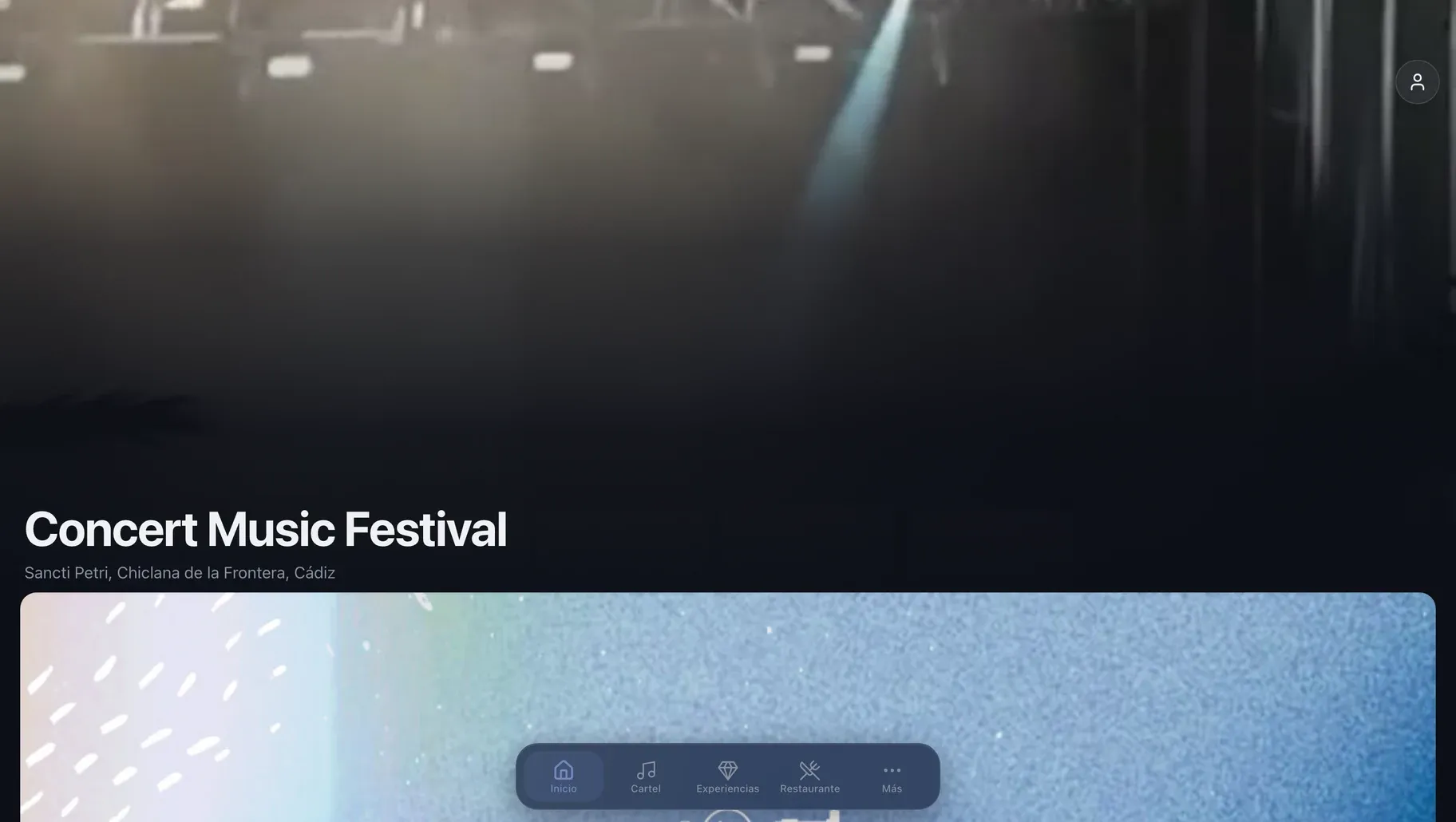
We met all three at once at Concert Music Festival in Sancti Petri, Cádiz. Its official app had the line-up compiled into the store binary, so adding an artist meant editing code and waiting for Apple and Google. Niña Pastori was missing from the app and the season started in ten days.
What we build
The app your audience actually uses on site: line-up and timetable, favourites, news, media, transport, food, FAQ and account. A content pipeline from the CMS your team already uses, so marketing publishes where it always did. Over-the-air updates, so copy, layout and fixes reach installed apps during the event weekend without a store review. Push that arrives, which is less obvious than it sounds. Static sites served from a CDN, indifferent to how many people show up at once. And release automation, so a version ships by pushing a git tag instead of by someone sitting in Xcode at midnight.
For Concert Music Festival we moved the whole backend off a no-code platform onto Polargate's own Supabase in four days (31 migrations, 26 tables with row-level security, 12 edge functions, 62 user accounts with their IDs preserved, 603 media files), rewrote the content layer to read the line-up live, and built a WordPress plugin with a sync that runs every 30 minutes. The app carries no WordPress references at runtime, so it keeps working when the website does not.
What it costs
A paid Discovery Sprint from 4,900 EUR: two weeks, fixed price, and you leave with scope, architecture and a budget. An event or venue site from 7,600 EUR. A native app for iOS and Android from 9,900 EUR. If you would rather not carry a build budget, some events run on an operating model instead, from 850 EUR a month plus scoped extras. Care, our senior maintenance retainer, starts at 850 EUR a month with a three-month minimum.
How we prove it
The 2026 Concert Music Festival edition ran with 37 shows between 10 July and 17 August, synchronised from the festival website every 30 minutes, with the app live in 177 countries on Android and relaunched on iOS. iOS push had registered zero device tokens in six weeks against roughly 600 active devices a day. We found two missing methods in the Swift AppDelegate, six lines of code, and by 27 August there were 149 opted-in devices. The end-of-season switch into next-edition mode shipped in a single day over the air, with no store submission. We also turned over-the-air updates off on Android after a bundle crashed the WebView on a real Galaxy, and instead of quietly moving on we added a circuit breaker and a remote kill switch. That is the standard we work to: 106 unit tests, an end-to-end smoke test, and an honest record of what broke. The festival is run as a continuing engagement rather than a one-off build, with each new piece of work scoped and quoted on its own.
Proof
Questions, answered
Can a festival app work with the website and ticketing platform we already use?
How much does a festival or venue app cost?
Can you change something in the app during the festival weekend without waiting for Apple?
Do we need a new app every year for the next edition?
Will our site stay up when tickets go on sale?
Who owns the app, the code and the store accounts?
Start the engine
Tell us what you are building in a few short questions. A senior engineer answers in writing within 48 business hours, with a first take on scope, timeline and price.