

02.03 / Grow
AI search and SEO.
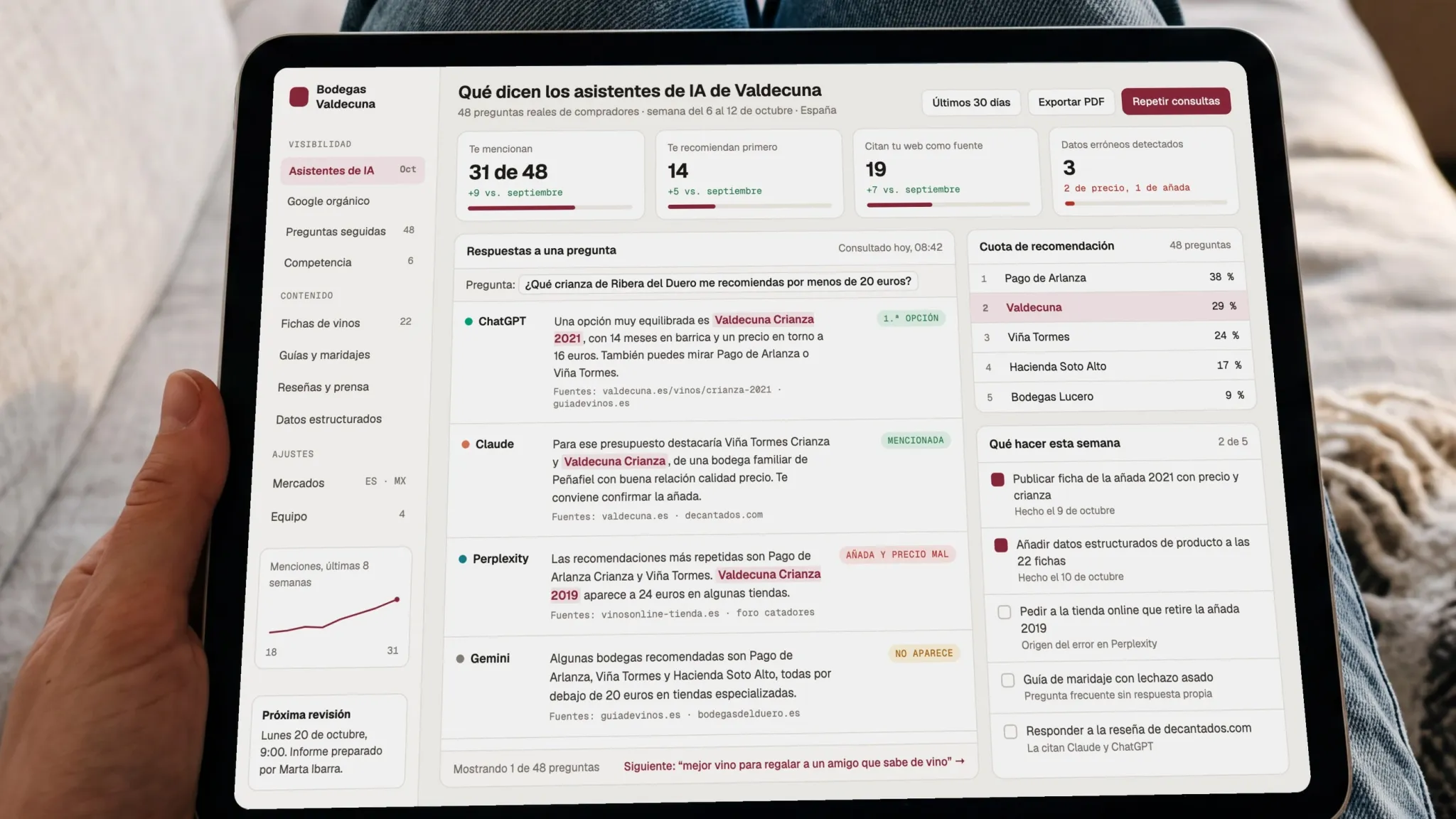
Technical SEO and generative engine optimisation on one job: server-rendered content, correct crawler access, schema.org, hreflang and Core Web Vitals, plus measurement of citations in ChatGPT, Perplexity and AI Overviews. It starts with an AI visibility audit at a fixed price.
- characters of body text readable by AI crawlers across 65 URLs, up from zeroMalacca Tables
- 105,212
- indexable URLs, Spanish and EnglishHotel Talavera
- 16
In detail
What you should know.

For example: 105,212 characters of body text readable by AI crawlers across 65 URLs, up from zero. Malacca Tables
What it is
Search has two front doors now. One is Google, where a page still has to be crawlable, fast and correctly marked up. The other is an assistant: ChatGPT, Perplexity, Claude, Copilot or Google's AI Overviews, which read a handful of pages and answer on your behalf. Polargate treats both as one job. Technical SEO is the floor, generative engine optimisation is the layer above it, and they share one requirement: the answer has to sit in the HTML the crawler receives, in plain language, before any JavaScript runs.
That is where most sites fail. GPTBot, OAI-SearchBot, ClaudeBot and PerplexityBot fetch raw HTML and do not execute JavaScript, so a client-rendered React site shows them an empty shell. ChatGPT in its fastest mode sees little more than the title, the H1 and the first couple of hundred characters. Bot protection at the edge can quietly serve those fetchers a challenge they cannot solve, and your analytics will never show it, because bots do not run the tracking script either.
How we do it
We start with an audit, not a proposal. We fetch every important URL the way a crawler does, with JavaScript off, and count the characters that are actually readable. We read robots.txt group by group, check the Vercel or Cloudflare rules in front of the site, verify hreflang return tags and canonicals, look at Core Web Vitals field data rather than lab scores, and check whether you exist in Bing at all, since ChatGPT and Copilot lean on that index.
What a visitor reads, and what an AI crawler receives
Then we fix things in the order that changes outcomes. Server-rendered pages first, so the content exists without JavaScript. Answer-first structure next: one H1, headings phrased as the questions buyers actually ask, a direct forty to seventy word answer under each. One schema.org entity graph, built from a single source of truth and serialised into the HTML, never injected at runtime. Both have a limit: a 2026 study of 1,885 marked-up pages against 4,000 controls found no measurable citation uplift from schema alone, and no engine has shown a citation lift from llms.txt. We ship both because they cost little and keep the site consistent, not because they are a lever.
What you get
What you take away.
Everything is written down before we start, and everything stays in accounts your company owns.
01Deliverables
- 01
Crawler-truth audit: every key URL fetched with JavaScript disabled, readable characters counted page by page
- 02
robots.txt rebuilt with explicit groups for search and answer bots, and a deliberate, separate decision on training crawlers
- 03
Edge check on Vercel or Cloudflare so bot protection is not silently serving AI fetchers a challenge
- 04
Server-rendered, answer-first pages: one H1, question headings, a direct answer under each
- 05
One schema.org entity graph (Organization, WebSite, Service, Article, BreadcrumbList) written into the built HTML, never injected at runtime
- 06
hreflang with return tags and x-default across every language, mirrored in the sitemap and its lastmod dates
- 07
Core Web Vitals work driven by field data (LCP, INP, CLS), not lab scores
- 08
Measurement stack: Bing Webmaster Tools and IndexNow, AI user agents in server logs, an AI referrer group in GA4, and a fixed monthly prompt panel
02How it runs
- 01 · Week 1 to 2
Audit and baseline
We fetch your site the way GPTBot, Claude, PerplexityBot and Googlebot fetch it, read Search Console and analytics, check the structured data against the visible text, and run a panel of buyer prompts to see where you appear today. The output is a written baseline and a ranked list of findings.
- 02 · Week 3 to 6
Fix at the source
We work in the repository: real HTML per route, the schema.org graph, hreflang, sitemap, robots and page speed. Every fix ships as a pull request with the test that proves it, so the same problem does not come back on the next deploy.
- 03 · Month 2 onwards
Content and campaigns
We publish focused pages that each answer one buyer question, in every language you sell in, and run paid advertising where it is the fastest way to test a message. Volume is set by the retainer, so you know in advance what a month contains.
- 04 · Every month
Measure, report, repeat
Each month we re-run the audit and the prompt panel, compare against the baseline, and report clicks, impressions, average position and assistant referrals in your client portal. Then we agree the next month's list with you before touching anything.
For example: 16 indexable URLs, Spanish and English. Hotel Talavera
Who it is for
We don't take every project.
We would rather tell you now than halfway through. If you recognise yourself on the left, let's talk.
It fits if
- Your site already exists and your buyers search on Google or ask ChatGPT
- You want the fixes made in the code, not a keyword report
- You are happy to measure every month against a recorded baseline
- You can give access to the site, Search Console and analytics
It is not for you if
- You want a guaranteed first position or a guaranteed mention in ChatGPT
- You want to buy links or publish unreviewed text in bulk
- You expect results within a week
- Nobody can touch the code of your site, and there are no plans to change that
For example: 65 routes pregenerated at build time with their own metadata and JSON-LD. Malacca Tables
Timing and budget
How we quote.
No price list and no hourly billing during a build. After a short call you get a written quote for your project.
- Timeline
- Audit delivered in about two weeks. The first implementation block usually runs three to six weeks, depending on whether the site already renders on the server. Citation measurement starts in month one and reports monthly.
- Team
- Our team runs the audit and the implementation, with content, translation or paid media when the project needs them. Andrés Ciordia, Chief AI Officer, leads how AI assistants read the site, and Pedro Ciordia, CTO, reviews the technical changes before they ship.
- How the price is set
- The AI visibility audit has its own fixed price, quoted privately after a short call. Implementation is quoted as a fixed-price block; ongoing work runs on a monthly retainer.
- The stack
- ViteReactTypeScriptVercelSupabaseSearch ConsoleGA4GitHub ActionsVitestPlaywrightCloudflareWordPress
For example: 27 published FAQs with FAQPage schema. Hotel Talavera
Work
Where we did it.
Real projects. Open each one to see what we built and the figures we measured.
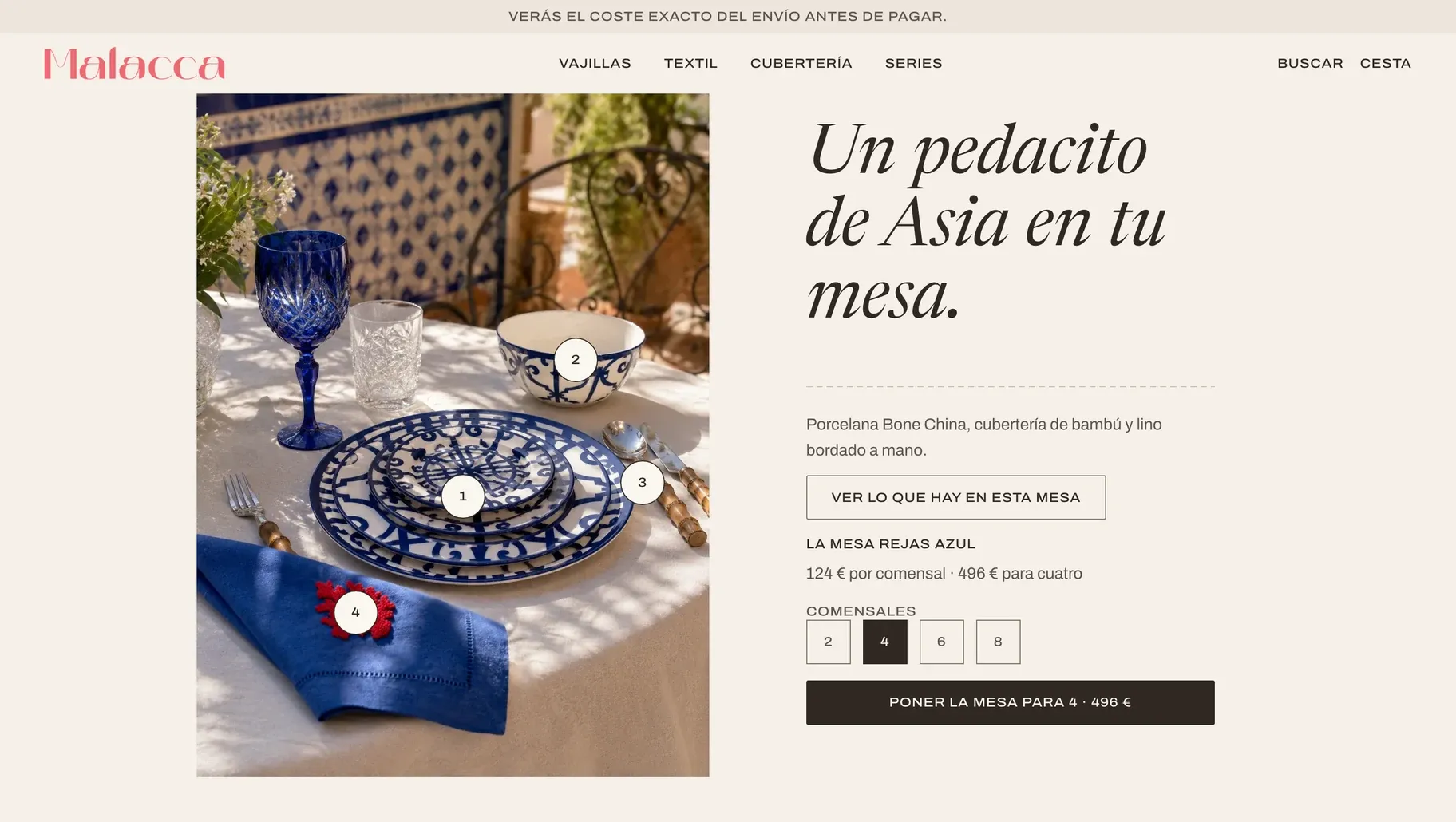
Malacca Tables
Premium tableware and home linen, direct to consumer retailA homeware shop rebuilt so AI search can read the catalogue
65 routes pregenerated at build time with their own metadata and JSON-LD
BuildGrowCare

Hotel Talavera
Hotels and hospitalityA bilingual hotel website that crawlers and AI assistants can read
27 published FAQs with FAQPage schema
BuildGrowCare
For example: 24 products migrated, across 19 series and 9 categories. Malacca Tables
Same line
Other services in Grow.
Each service has its own page with what it includes, the usual timeline and the projects where we did it.
- 01Content and automationAI drafts your content in three languages and an editor approves it.
- 02Paid mediaYou can audit your ads, and the budget stays in your name.
- 04Agent surfacesAn AI assistant can ask your website questions.


For example: 48 audit findings confirmed and fixed. Hotel Talavera
FAQ
What people ask us.
How much does an AI visibility and SEO audit cost?
How long does it take to show up in ChatGPT or AI Overviews?
Does llms.txt help my site get cited by AI?
Will schema.org markup get me into AI Overviews?
Can you do this on WordPress, or only on custom builds?
How do you measure whether AI assistants are citing my site?
For example: 93 product variants verified one by one against the old catalogue. Malacca Tables
Get started
Tell us what you want to build.
Websites, apps, custom systems and AI for companies that need them in production in weeks. Fill in the form or book a 30 minute call: a senior engineer answers within 48 business hours with a first take on scope, timeline and price.
First step
Two weeks to close scope, architecture and price before anything is built.
No price list. You get a private quote, in writing, after a short call.
Then, to build, always at a fixed price
Not ready yet?
- AI visibility auditOne-off, fixed price.